
Are you a big fan of rules, or are you a bigger fan of breaking rules?
I have found that the first of each year has always been the very best time to sort through and prioritize which rules need to be followed more closely for a better result in the new year.
What rules are we talking about? Undoubtedly, on posters or in books, you may have heard some of these popular rules:
- “I before E, except after C” is a mnemonic rule of thumb for English spelling.
- The “Golden Rule” is the principle of treating others as one would want to be treated by them.
- Be You — Be yourself, everyone else has already been taken.
- Start Now — Do want you can, with what you have, where you are.
- Take Action — A journey of 1,000 steps begins with the first step.
- Serve Others — People will never forget how you made them feel.
- Be Brave — Life shrinks or expands in proportion to one’s courage.
- Believe — Believe and act as if it were impossible to fail.
- Work Hard — The difference between ordinary and extraordinary is that little extra.
- It’s On You — If opportunity doesn’t knock, build a door.
- Take Chances — You miss 100% of the shots you don’t take.
- Forgive — For every minute you are angry, you lose 60 seconds of happiness.
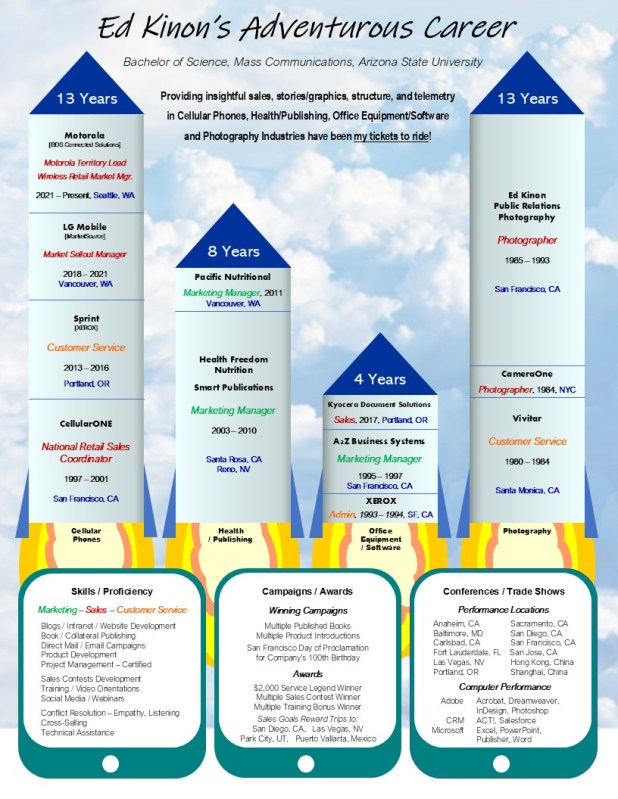
As you can see with my attached career infographic, I have had an adventurous career with positions up and down those “Sales Funnel Rules” where marketing positions attract customers, sales positions complete sales, and customers service positions keep customers.
All these rules mentioned above speak to self-motivation and better spelling, but I have found over the years and in different positions that in the world of business, there are really only two main rules:
- The Rule for Companies/Corporations — The 80-20 Rule, also known as the Pareto principle, states that 80% of outcomes come from 20% of causes which for many companies means that 80% of sales or profits are from 20% of their products or services.
- The Rule for Workers — The 60, 30, 10 Rule states that 60% of a career is showing up enthusiastically and winning over other people, 30% is your craftsmanship, and 10% is the quality of your company’s products or services.
Since I am identifying the 60, 30, 10 Rule let me fully explain.
- The 60 Percent — In my career I have witnessed the most successful people are constantly winning over upper management, coworkers, and customers. How are they doing that? They do it with daily enthusiasm, while asking probing questions then listening to updates to keep learning what has changed. They are determined to improve any situation.
- The 30 Percent — This is our skill set. In my world of communications, this is my ability to be a good storyteller, salesperson, trainer, branding agent, project manager.
- The 10 Percent — This part of our business success has to do with the quality of our company’s products or services.
60, 30, 10 Rule Learning Opportunities
The 60 Percent — It certainly helps if daily enthusiasm, fascination with others, wanting to always improve results, and superior reporting skills are part of someone’s DNA.
Personally, my advantages in this area have included:
- The Oldest — Being the oldest of four kids where I learned quickly that just pushing my agenda forcefully did not always work. I needed to offer entertaining options that aligned with what I thought needed to be done, or what had been assigned to me to get done.
- The Mover — Our father using his carpenter skills often moved us to the next fastest growing community. In the twelve years of grade school, I attended over twenty schools. Consequently, I learned to make friends very quickly, and I learned the world is relative, what was important in one neighborhood did not always resonate with other neighborhoods.
- Journalism School — Graduating with a journalism degree from college at a young age has been a major advantage over many coworkers. Learning how to build rapport, gather fresh information, how to capture someone’s attention either in person or on documents, providing compelling insights, offering solutions, and always adding kicker rewards for absorbing all that I wanted to share has constantly elevated my contributions, provided me major rewards, and opened many, many doors for more opportunities.
How has your history helped build your skills and elevated your enthusiasm?
The 30 Percent — At the beginning of each new year I find myself focusing mostly on this 30%, our skill sets:
- What happened lately?
- Have I been building a larger audience?
- Was I going too fast and losing people?
- Was I going too slow in my presentations and losing my audience?
- Each audience has its own download speed. Was I making proper adjustments to those different audiences?
- Did my project management skills hold up to all those additional deadlines?
- What skills did I really add in the last year?
The 10 Percent — Having faith in your company’s management, products, or services either builds over time or it doesn’t. If you still have the faith, there may not be a need to move this upcoming year. If you have lost that faith, then it is time to find something new.
At the beginning of each year, it makes sense for each worker to prioritize what area of the 60, 30, 10 Rule needs the most attention for improvements in the new year, and it may be easier to work backwards:
- The 10 Percent — Are you happy with your company’s performance, products, or services?
- The 30 Percent — Are you happy with your skill set? What needs to be improved to secure a more promising future?
- The 60 Percent — This is the big one. Where is your enthusiasm about yourself, others around you, your customers, your products, or the marketplace? This 60% is really the culmination of the faith and improvements of the other 40%, isn’t it?
Building Business Performance
For me, building business performance feels a lot like the steps to be a better tennis player:
- Meeting Opportunities — Whenever anyone starts to learn the game of tennis they have to learn to get their body in the proper position for best results on each shot. Once in position they identify the trajectory of the incoming tennis ball so they can meet that ball with their racket to move the ball back to where they want to apply pressure against their opponent.
- Improving Skills and Performance — Initially, tennis players pounced on each shot with power and vigor. As their hand-eye coordination improves they begin to experiment with slice shots where they provide backspin on their shots.
- Improving Agendas — Suddenly, these tennis players with slice shots have so much more control on their agenda because they can use both power or more finesse to score their points. With each success, agendas are adjusted in hopes of securing even larger results!
- Winning Results — Armed with improving tennis skills, more confidence, more success, increased enthusiasm, more stamina, and enhanced poise winning becomes easier and easier.
Each year, these have been my steps to both improve my tennis game and improve my personal business results because I constantly want to get better at both. I want to learn both from others, and from my own experiences.
In a sense most of us absorb social media including LinkedIn updates to see what we can apply to our own activities. At our best, our United Stated of America experiment is about rules, competition, leverage, adaptability, courage, teamwork, influence, achievements, and renewal.
‘Tis the season for renewal. As we start 2025 artificial intelligence (AI) will wash over all of us more and more. With AI, companies are changing, people are changing, our attention spans are changing, and our society is certainly changing faster than ever in the past. This is not the time for waning enthusiasm as, in my mind, enthusiasm makes up 60 percent of who we are, and how the best among us propels our prosperity.
Whatever 2025 has in store for us, be it easy, convenient, annoying, or impossible (my four project categories), let’s all enhance our enthusiasm to help each other more and more this year.
Join the Daily Enthusiasm Party! I have a feeling this approach will only help us all, and Happy New Year!
 Cache of Communiqués