

Below are various assessments that verify my talents, my nature, my attitude, my behavior, and my cultural fit.
“All action is a form of speech. Language is the shape life takes passing through us; it is how we pay homage to things and preserve them . . . What one works toward is this: that there be no difference between the man, the life, the voice, that all becomes a way of standing in the world, a kind of witness.”
– PETER MARIN, In a Man’s Time
Plum Assessment
RoundPegg Assessment
Clifton StrengthsFinder Assessment
Myers-Briggs Type Indicator® (MBTI®) Assessment
Taylor Protocols Assessment

Plum Assessment
Plum is a cloud-based pre-employment assessment solution which assesses candidates on their problem-solving abilities, behavior and attitude, and social intelligence.
ED KINON
Adaptation
Your Adaptation is in the top 5% of the workforce. You have an extraordinary proficiency for adjusting to changes in the workplace while maintaining a positive demeanor.
 You can remain calm, level-headed and operate effectively in the midst of stressful situations and under multiple or conflicting demands.
You have an extraordinary ability to change your approach to best fit the situation, analyze problems and develop new solutions.
You have an extraordinary ability to learn and apply new skills, adjust effectively to different and changing environments, and smoothly integrate changes into your work habits.
You have an ability to deal positively with obstacles and failures, accept criticism and feedback, and use intuition and experience to complement data.
Persuasion
Your Persuasion is in the top 15% of the workforce. You have a strong proficiency for convincing others of a direction, activity or idea and influencing the decision making processes.
 You have an extraordinary ability to be friendly, excited, and socialize with large groups, helping you to attract people and be influential.
You have an strong ability to sway the thinking and behavior of co-workers and customers who initially disagree.
You generally know what to say to people in order to influence them without making them upset.
You can be collaborative, confident and accepting of criticism.
Cultural Awareness
You have a proficiency for understanding the perspective of others, and dealing effectively with different types of people.
 You have an extraordinary disposition for being curious, reflective and studying people and their values.
You have an extraordinary disposition for adapting to a wide range of people, and being open to differences in attitudes, values and personalities.
You can communicate in a tactful and considerate manner in difficult situations, and help others settle interpersonal conflicts.
RoundPegg Assessment
RoundPegg provides a Culture and Engagement Platform to help companies hire, develop, and engage employees through the lens of Culture Fit.
Their proven platform and methodology increases identifying and hiring top performers by 20% and decreases employee churn with high RoundPegg fit by nearly 30% and naturally drives engagement across the company by giving managers the tools they need to promote and coach employees and measure engagement.
ED KINON
Your Culture Survey Results
The scores below reflect where you stand as a percentage of the population. For example, 25 means you prefer that culture type more than 25% of the population. These will not add up to 100.
Value Strength – 91
Culture Type – Culture: Collaboration
 Collaborative cultures value synergy and cooperation. Individuals are expected to listen to others’ ideas and treat each other with respect. The open, sharing environment often results in prolonged decision-making – with individuals sometimes refraining from voicing dissent. Individual achievement is generally sacrificed in lieu of celebrating team success.
PREFERENCES
- synergy, support and cooperation
- considering others’ ideas
- working together to reach goals
- open, transparent communication with
- decisions made by consensus
WORKING WITH ME
- be cooperative and encouraging
- invite me to work with you
Value Strength – 77
Culture Type – Culture: Command
 Command cultures value certainty, precision, and dependability. Roles are clearly defined and systems and policies are in place to ensure that things are done the same way every time. Direction tends to come from the top and trickle down – so ideas within the organization may get lost. Focus is placed on process over people with the environment feeling structured and serious.
Value Strength – 50
Culture Type – Culture: Cultivation
 Cultivation cultures value bringing out the best in individuals. Focus is on potential and providing opportunities for growth, with less importance placed on rules and controls. The environment is people-focused and individuals generally feel inspired to develop their abilities. Systems can be relatively inefficient when people are prioritized over details.
Value Strength – 23
Culture Type – Culture: Competence
 Competence cultures value winning and being the best. People are expected to be experts in their field – generalists are not typically appreciated. Performance standards are very high and individuals are expected to stand up for their ideas, rather than focusing on building consensus. The environment is pressure-packed and very individualistic. Because of this, decision-making is thorough and the solutions deemed strongest win out.
Ed’s Top Values
Adaptability – Ask me to help you quickly shift directions
Being People Oriented – Invite me to work with you
Creativity – Task me with identifying a new approach
Decisiveness – Give me a quick decision to make
Finding Compromise – Ask me to find a middle ground
Paying Attention to Detail – Ask me to attend to the details
Rewarding Team Success – Don’t reward me, reward my team
Seeking Consensus – Ask me to create consensus
COMMUNICATION TYPE – Guide
PREFERENCES
- seek input from others before finalizing direction
- provide several options for achieving goals
- retain much control but ask others to contribute
WORKING WITH ME
- come to me for suggestions
- provide/request options that might work
PERSONALITY TYPE – Driver
PREFERENCES
- be focused and persistent
- create plans and energetically drive them to completion
- think best when talking through information with others
WORKING WITH ME
- give me the goal to achieve
- ask me to craft an action plan
Now, Discover Your Strengths – Clifton StrengthsFinder Assessment
In the early 1950s, Donald O. Clifton, who would go on to be named the “Father of Strengths Psychology,” noticed a major problem: The field of psychology was based almost entirely on the study of what is wrong with people. He wondered if it would be more important to study what is right with people.
 So, over the next five decades, Don and his colleagues at The Gallup Organization took a very close look at the talents of highly successful people, focusing on the positive instead of the negative. Millions of in-depth interviews were conducted to determine the most natural thoughts, feelings, and behaviors of “the best of the best.”
They quickly discovered that our talents do more than make us unique individuals. When we follow our talents – the ways in which we naturally think, feel, and behave – they also serve as our best opportunities for true excellence.
To help you discover your greatest talents and build toward strengths, Don and his colleagues created the Clifton StrengthsFinder.
During your assessment, you gave top-of-mind responses to a wide variety of paired statements. Those instantaneous responses are valuable information. Why? Because they are clues to your talents in 34 areas directly connected to success in any role, whether at work, at home, or in the community.
The Clifton StrengthsFinder has measured your talents in those 34 areas, or “themes.” Now, to point you in the right direction, it presents you with a report of the five areas in which your greatest talents are found. And to help you further discover your talents, it provides full descriptions of those areas, along with “sounds likes,” which are examples of what people with talents similar to yours might say. You will find your personal top five report and brief descriptions of the 34 talent areas measured by the assessment in the pages following this introduction.
Of course, your “top five” are just a starting point as you move from the potential of talent to the excellence of strength in action. Along the way, you can find many opportunities for discovery and development in your relationships with family members, friends, and colleagues.
Ed Kinon
Your Top 5 Strengths
Ideation
You are fascinated by ideas. What is an idea? An idea is a concept, the best explanation of the most events. You are delighted when you discover beneath the complex surface an elegantly simple concept to explain why things are the way they are. An idea is a connection. Yours is the kind of mind that is always looking for connections, and so you are intrigued when seemingly disparate phenomena can be linked by an obscure connection. An idea is a new perspective on familiar challenges. You revel in taking the world we all know and turning it around so we can view it from a strange but strangely enlightening angle. You love all these ideas because they are profound, because they are novel, because they are clarifying, because they are contrary, because they are bizarre. For all these reasons you derive a jolt of energy whenever a new idea occurs to you. Others may label you creative or original or conceptual or even smart. Perhaps you are all of these. Who can be sure? What you are sure of is that ideas are thrilling. And on most days, this is enough.
Strategic
The Strategic theme enables you to sort through the clutter and find the best route. It is not a skill that can be taught. It is a distinct way of thinking, a special perspective on the world at large. This perspective allows you to see patterns where others simply see complexity. Mindful of these patterns, you play out alternative scenarios, always asking, “What if this happened? Okay, well what if this happened?” This recurring question helps you see around the next corner. There you can evaluate accurately the potential obstacles. Guided by where you see each path leading, you start to make selections. You discard the paths that lead nowhere. You discard the paths that lead straight into resistance. You discard the paths that lead into a fog of confusion. You cull and make selections until you arrive at the chosen path-your strategy. Armed with your strategy, you strike forward. This is your Strategic theme at work: “What if?” Select. Strike.
Maximizer
Excellence, not average, is your measure. Taking something from below average to slightly above average takes a great deal of effort and in your opinion is not very rewarding. Transforming something strong into something superb takes just as much effort but is much more thrilling. Strengths, whether yours or someone else’s, fascinate you. Like a diver after pearls, you search them out, watching for the telltale signs of a strength. A glimpse of untutored excellence, rapid learning, a skill mastered without recourse to steps-all these are clues that a strength may be in play. And having found a strength, you feel compelled to nurture it, refine it, and stretch it toward excellence. You polish the pearl until it shines. This natural sorting of strengths means that others see you as discriminating. You choose to spend time with people who appreciate your particular strengths. Likewise, you are attracted to others who seem to have found and cultivated their own strengths. You tend to avoid those who want to fix you and make you well rounded. You don’t want to spend your life bemoaning what you lack. Rather, you want to capitalize on the gifts with which you are blessed. It’s more fun. It’s more productive. And, counterintuitively, it is more demanding.
Individualization
Your Individualization theme leads you to be intrigued by the unique qualities of each person. You are impatient with generalizations or “types” because you don’t want to obscure what is special and distinct about each person. Instead, you focus on the differences between individuals. You instinctively observe each person’s style, each person’s motivation, how each thinks, and how each builds relationships. You hear the one-of-a-kind stories in each person’s life. This theme explains why you pick your friends just the right birthday gift, why you know that one person prefers praise in public and another detests it, and why you tailor your teaching style to accommodate one person’s need to be shown and another’s desire to “figure it out as I go.” Because you are such a keen observer of other people’s strengths, you can draw out the best in each person. This Individualization theme also helps you build productive teams. While some search around for the perfect team “structure” or “process,” you know instinctively that the secret to great teams is casting by individual strengths so that everyone can do a lot of what they do well.
Woo
Woo stands for winning others over. You enjoy the challenge of meeting new people and getting them to like you. Strangers are rarely intimidating to you. On the contrary, strangers can be energizing. You are drawn to them. You want to learn their names, ask them questions, and find some area of common interest so that you can strike up a conversation and build rapport. Some people shy away from starting up conversations because they worry about running out of things to say. You don’t. Not only are you rarely at a loss for words; you actually enjoy initiating with strangers because you derive satisfaction from breaking the ice and making a connection. Once that connection is made, you are quite happy to wrap it up and move on. There are new people to meet, new rooms to work, new crowds to mingle in. In your world there are no strangers, only friends you haven’t met yet-lots of them.
Brief Descriptions of the 34 Themes of Talent Measured by the Clifton StrengthsFinder
Achiever People strong in the Achiever theme have a great deal of stamina and work hard. They take great satisfaction from being busy and productive.
Activator People strong in the Activator theme can make things happen by turning thoughts into action. They are often impatient.
Adaptability People strong in the Adaptability theme prefer to “go with the flow.” They tend to be “now” people who take things as they come and discover the future one day at a time.
Analytical People strong in the Analytical theme search for reasons and causes. They have the ability to think about all the factors that might affect a situation.
Arranger People strong in the Arranger theme can organize, but they also have a flexibility that complements this ability. They like to figure out how all of the pieces and resources can be arranged for maximum productivity.
Belief People strong in the Belief theme have certain core values that are unchanging. Out of these values emerges a defined purpose for their life.
Command People strong in the Command theme have presence. They can take control of a situation and make decisions.
Communication People strong in the Communication theme generally find it easy to put their thoughts into words. They are good conversationalists and presenters.
Competition People strong in the Competition theme measure their progress against the performance of others. They strive to win first place and revel in contests.
Connectedness People strong in the Connectedness theme have faith in the links between all things. They believe there are few coincidences and that almost every event has a reason.
Consistency People strong in the Consistency theme are keenly aware of the need to treat people the same. They try to treat everyone in the world with consistency by setting up clear rules and adhering to them.
Context People strong in the Context theme enjoy thinking about the past. They understand the present by researching its history.
Deliberative People strong in the Deliberative theme are best described by the serious care they take in making decisions or choices. They anticipate the obstacles.
Developer People strong in the Developer theme recognize and cultivate the potential in others. They spot the signs of each small improvement and derive satisfaction from these improvements.
Discipline People strong in the Discipline theme enjoy routine and structure. Their world is best described by the order they create.
Empathy People strong in the Empathy theme can sense the feelings of other people by imagining themselves in others’ lives or others’ situations.
Focus People strong in the Focus theme can take a direction, follow through, and make the corrections necessary to stay on track. They prioritize, then act.
Futuristic People strong in the Futuristic theme are inspired by the future and what could be. They inspire others with their visions of the future.
Harmony People strong in the Harmony theme look for consensus. They don’t enjoy conflict; rather, they seek areas of agreement.
Ideation People strong in the Ideation theme are fascinated by ideas. They are able to find connections between seemingly disparate phenomena.
Includer People strong in the Includer theme are accepting of others. They show awareness of those who feel left out, and make an effort to include them.
Individualization People strong in the Individualization theme are intrigued with the unique qualities of each person. They have a gift for figuring out how people who are different can work together productively.
Input People strong in the Input theme have a craving to know more. Often they like to collect and archive all kinds of information.
Intellection People strong in the Intellection theme are characterized by their intellectual activity. They are introspective and appreciate intellectual discussions.
Learner People strong in the Learner theme have a great desire to learn and want to continuously improve. In particular, the process of learning, rather than the outcome, excites them.
Maximizer People strong in the Maximizer theme focus on strengths as a way to stimulate personal and group excellence. They seek to transform something strong into something superb.
Positivity People strong in the Positivity theme have an enthusiasm that is contagious. They are upbeat and can get others excited about what they are going to do.
Relator People who are strong in the Relator theme enjoy close relationships with others. They find deep satisfaction in working hard with friends to achieve a goal.
Responsibility People strong in the Responsibility theme take psychological ownership of what they say they will do. They are committed to stable values such as honesty and loyalty.
Restorative People strong in the Restorative theme are adept at dealing with problems. They are good at figuring out what is wrong and resolving it.
Self-Assurance People strong in the Self-Assurance theme feel confident in their ability to manage their own lives. They possess an inner compass that gives them confidence that their decisions are right.
Significance People strong in the Significance theme want to be very important in the eyes of others. They are independent and want to be recognized.
Strategic People strong in the Strategic theme create alternative ways to proceed. Faced with any given scenario, they can quickly spot the relevant patterns and issues.
Woo People strong in the Woo theme love the challenge of meeting new people and winning them over. They derive satisfaction from breaking the ice and making a connection with another person.
Myers-Briggs Type Indicator® (MBTI®) Assessment
This report is designed to help you understand your results on the Myers-Briggs Type Indicator® (MBTI®) Assessment.
The MBTI assessment is a tool for identifying 16 different personality types that can be used to describe people: ISTJ ISFJ INFJ INTJ ISTP ISFP INFP INTP ESTP ESFP ENFP ENTP ESTJ ESFJ ENFJ ENTJ.
ED KINON
Your responses to the MBTI assessment indicate that your four-letter type code is:
ENFP Extraverted Intuition with Introverted Feeling
Where Do Personality Types Come From?
The MBTI instrument is based on the work of psychologist Carl Jung and the instruments authors, Isabel Briggs Myers and her mother, Katharine Cook Briggs, all of whom spent years observing human behavior. Their ideas help explain why different kinds of people are interested in different things, prefer different kinds of work, and sometimes find it hard to understand each other all due to basic differences in how people take in information and make decisions about it. The MBTI instrument was developed with great care and has been used by people around the world for more than 60 years.
- Organizations use it to improve employee communication, teamwork, and leadership.
- Adults and young people use it to choose careers that are likely to hold their interest
- Teachers and students use it to make learning more interesting and efficient.
- Family members use it to better understand each other.
Isabel Briggs Myers created descriptions of each of the 16 types, including the description of your type that is included in this report. Your Report also provides information on why the 16 types are different from one another and clarifies how ENFP is distinctive from the others. A clear understanding of the basics of personality type and type development will help you gain greater understanding of yourself and others and the impact type has on your daily interactions.
How Your Responses Indicate Your Type: ENFP
When you completed the MBTI assessment, you made choices on four dichotomies, each of which is made up of two opposite preferences:
Where you focus your attention
Extraversion (E) <<- or ->> Introversion (I)
The way you take in information
Sensing (S) <<- or ->> Intuition (N)
The way you make decisions
Thinking (T) <<- or ->> Feeling (F)
How you deal with the outer world
Judging (J) <<- or ->> Perceiving (P)
Although everyone uses all eight of these preferences, people find one preference in each pair more interesting or comfortable than its opposite. Think of your choices as somewhat like being right- or left-handed. Both hands are valuable, but most people reach first with the hand they prefer. They usually use that hand more often and become more skillful with it. In the same way, your type preferences are choices between equally valuable and useful qualities.
Your responses to the MBTI instrument indicate that you expressed preferences for ENFP, as shown in the chart below.
ENFP
| Two different ways of focusing your attention |
E – Extraversion People who prefer Extraversion tend to relate easily to the outer world of people and things. |
I – Introversion People who prefer Introversion tend to relate easily to the inner world of ideas and impressions. |
||
| Two different ways of taking in information |
S – Sensing People who prefer Sensing tend to be interested in what the five senses show them – what exists in the present. |
N – Intuition People who prefer Intuition tend to use their imagination to see new possibilities and insights focusing on the future. |
||
| Two different ways of making decisions |
T – Thinking People who prefer Thinking tend to base decisions on objective analysis and logic. |
F – Feeling People who prefer Feeling tend to base decisions on values and people-centered concerns. |
||
| Two different ways of dealing with the outer world |
J – Judging People who prefer Judging tend to like to have things decided; life is likely to be planned and orderly. |
P – Perceiving People who prefer Perceiving tend to not want to miss anything; life is likely to be spontaneous and flexible. |
Your Type Description: ENFP – The Inspirer
Enthusiastic, idealistic, and creative. Able to do almost anything that interests them. Great people skills. Need to live life in accordance with their inner values. Excited by new ideas but bored with details. Open-minded and flexible, with a broad range of interests and abilities.
As an ENFP, your primary mode of living is focused externally, where you take things in primarily via your intuition. Your secondary mode is internal, where you deal with things according to how you feel about them, or how they fit in with your personal value system.
ENFPs are warm, enthusiastic people, typically very bright and full of potential. They live in the world of possibilities and can become very passionate and excited about things. Their enthusiasm lends them the ability to inspire and motivate others, more so than we see in other types. They can talk their way in or out of anything. They love life, seeing it as a special gift, and strive to make the most out of it.
ENFPs have an unusually broad range of skills and talents. They are good at most things which interest them. Project oriented, they may go through several different careers during their lifetime. To onlookers, the ENFP may seem directionless and without purpose, but ENFPs are actually quite consistent, in that they have a strong sense of values which they live with throughout their lives. Everything that they do must be in line with their values. An ENFP needs to feel that they are living their lives as their true Self, walking in step with what they believe is right. They see meaning in everything and are on a continuous quest to adapt their lives and values to achieve inner peace. They’re constantly aware and somewhat fearful of losing touch with themselves. Since emotional excitement is usually an important part of the ENFP’s life, and because they are focused on keeping “centered”, the ENFP is usually an intense individual, with highly evolved values.
An ENFP needs to focus on following through with their projects. This can be a problem area for some of these individuals. Unlike other Extraverted types, ENFPs need time alone to center themselves, and make sure they are moving in a direction which is in sync with their values. ENFPs who remain centered will usually be quite successful at their endeavors. Others may fall into the habit of dropping a project when they become excited about a new possibility, and thus they never achieve the great accomplishments which they are capable of achieving.
Most ENFPs have great people skills. They are genuinely warm and interested in people, and place great importance on their inter-personal relationships. ENFPs almost always have a strong need to be liked. Sometimes, especially at a younger age, an ENFP will tend to be “gushy” and insincere, and generally “overdo” in an effort to win acceptance. However, once an ENFP has learned to balance their need to be true to themselves with their need for acceptance, they excel at bringing out the best in others, and are typically well-liked. They have an exceptional ability to intuitively understand a person after a very short period of time and use their intuition and flexibility to relate to others on their own level.
ENFPs are basically happy people. They may become unhappy when they are confined to strict schedules or mundane tasks. Consequently, ENFPs work best in situations where they have a lot of flexibility, and where they can work with people and ideas. Many go into business for themselves. They have the ability to be quite productive with little supervision, as long as they are excited about what they’re doing.
ENFPs are charming, ingenuous, risk-taking, sensitive, people-oriented individuals with capabilities ranging across a broad spectrum. They have many gifts which they will use to fulfill themselves and those near them, if they are able to remain centered and master the ability of following through.
Taylor Protocols Assessment
Taylor Protocols, Inc., based in Seattle, Washington, is a business Management Technology company serving the Business Consulting, Coaching, Permanent Placement, Employment Services and HR Technology markets.
Taylor Protocols, Inc. has developed the 80/20 Protocol™, a revolutionary business optimization system consisting of top performer profiling and automated candidate prescreening.
The Company’s products are the first ever effective predictor of future top performance. In longitudinal studies, this system has demonstrated the ability to increase hiring effectiveness and employee productivity, reduce hiring costs and decrease turnover in hundreds of companies.
All of the Taylor Protocols are made possible by the CVI™, and the Web distribution of the CVI assessment process, as well as the automatic Top Performer profile algorithms, and automated matching of candidate/employee profiles with Top Performer Profiles™ in a given position.
It is the CVI™ that makes the Taylor Protocols possible. It is the Taylor Protocols that makes the CVI useful in every business.
The CVI is the only assessment that characterizes and quantifies what Abraham Maslow called the unchanging innate nature of a person that inscribes where a person can make their highest and most productive contribution to the world.
Because of this we have the only human assessment process that provides 94% repeat score reliability, year over year. Other assessments typically provide reliability between 60% and 80%. These numbers attest to the fact that we are capturing the innate unchanging nature of people. This factor makes the CVI™ the only assessment that can and should be used as a pre-screening tool for employment application processes.
My Taylor Protocols Profile. Enjoy the video!
ED KINON
62% of your core value energy comes from Love and Wisdom.
Ed, the CVI assessment found you are a MERCHANT-INNOVATOR.
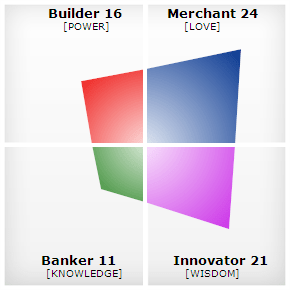 What does this mean? This means your primary core value is Merchant – A Merchant’s core value energy is Love. Love in this sense is working toward an inspired vision of what can be, by nurturing the core values in one’s self and in others. You thrive at building relationships and providing an inspired vision for those around you.
Your secondary core value is Innovator – An Innovator’s core value energy is Wisdom. Wisdom is the ability to see the way things are, and discern what to do about it. You accurately assess situations and provide solutions.
You have been sent an email with a link to this report. Come back often – the information provided below is continually updated with exciting new insights. Lastly, Share the CVI with others. We encourage you to gift others with this unique, life changing assessment. How would your life be better if you truly understood how you and those around you naturally participate in this world?
WHO I AM
Your scores indicate you have MERCHANT/INNOVATOR tendencies. When you enter a room there is more love and wisdom energy suddenly in that room. You are the presence of wise love. This is your assignment, to be the effective presence of wise love. You look at the circumstances and situations around you through the eyes of truth and compassion. You operate from reason and cognitive thinking, to learn who people really are, and what they need and want. You focus on nurturing and supporting others and yourself. This is balanced by your intuitive/reasoning capacity to see the ways things are. You observe situations until you understand, providing the best responses, strategies and solutions. Your highest and best contribution can only be made in situations in which there is a significant and constant need for wise love.
Who you are at the deepest innate level of your human nature is the most important element in your life. Who you are at this deep level, is, after all, the only thing you really contribute to this world. It is through right assignment and effective choices that you make your highest and best contribution. This is the universal mission of all people.
The more you learn about who you really are, and how to optimize your presence in this world, the greater will be your success, happiness and life effectiveness.
Your dominant Merchant value energy is balanced by your Innovator secondary value energy. Your actions are routinely, almost equally, guided by these two core energies. In times of distress you will usually rely on the conflict strategies of your dominant core energy. In less critical conflicts you may use either conflict strategy given the situation.
Your unique dominant MERCHANT core energy causes you to rely upon the following strategies for success and fulfillment.
Your cornerstone core value is love. Building and sustaining relationships is central to your life’s strategy. You are constantly working to know and understand the truth about yourself and others.
You like to have a good sense of connection between what you are doing today and what you see in your future. You like discovering new possibilities, and you consistently watch for them. Nothing feels right when the people you value are distant or are in conflict. You have a natural enthusiasm and like to be in situations that are fully engaging and energized. No potential plan, idea or possibility gets by you. A core strategy for you is to work effectively with others. Share your knowledge and information with others; you enjoy it and others appreciate it.
You are good at getting others to work for and with you. Choosing your words carefully works well for you. Feeling a sense of togetherness with people gives you confidence. You like a new charge in your life and you like to be the charge in the lives of others. You like to trust people and to share yourself with them freely. You enjoy lots of different people and activities. Charm and enthusiasm are part of your arsenal for success.
Too much formality is boring and restrictive. Free and open discussion is a major element in your leadership style. Motivating others with your visions and ideas is very satisfying. Talking with others is your way to learn and to teach. Something new and inspiring everyday is the spice of your life. Being of high value to others and seeing high value in others is a prime concern. You have the ability to help people feel hopeful and courageous.
It is important for you to see people and things as they really are.
Your unique secondary INNOVATOR core energy supports your dominant MERCHANT core energy.
Your second cornerstone core value is wisdom. Understanding and compassion are central to your life strategy.
Strategic thinking is your forte. You see and understand the relative worth of people and things. Development of effective responses to situations is one of your primary contributions. If different things can be brought together from different resources, you will do it. You strive to cause people and things to function well together. You like to maintain a good mix of people, activities and things in your life. Your willingness to see things through and wait things out is a primary asset.
You like to communicate with visuals and descriptions. People look to you for the creation and improvement of work flow and procedures. You have wit and creativity in your thinking. You can always see another way to put things together. It is important for you to watch, look and listen before you act. Finding the best solution is one of your primary contributions. You like to consider all the options.
Rapid and clever exchange of ideas is a personal joy and a method of work for you. You are able to see the ways things are, and you know what to do about it. You are seen as a valuable resource for leading people toward the right ideas and the right direction. You like to lead through presentation of intelligent alternatives. Acting foolishly or illogically is not a common experience for you. Your use everything that is available to meet requirements. You value and rely upon your mental abilities.
MERCHANTS-Your Dominant Core Energy
Merchants tend to be exceptional team builders. They motivate people, are constantly excited by new ideas, and never ask if something is possible. They assume every idea is a possibility. In fact, just having an idea is cause for celebration and reward as far as merchants are concerned. They believe that nothing happens without a good idea.
The power of merchants comes from their willingness to think about, consider and expose one good thought after the next. They think as they speak, changing and modifying their vision in real time. Since every business is a constantly changing organism, merchants are invaluable resources.
Their excitement is infectious, and people work better when they feel energized. Unlike builders, merchants get little satisfaction from feeling their own considerable energy. Merchants thrive on infecting the world around them with excitement toward the common vision. They not only create teams, they also inspire, motivate and direct teams toward real (and sometimes imagined) opportunities.
Merchants also have an appreciation for culture, art, literature, quality of presentation, and aesthetics. Without the merchant mind involved in a business, the workplace can become an abyss of chaotic builder dictates on scratch pads, banker spreadsheets and reports, or innovator block diagrams and technical manuals.
Merchants attract others to them, an invaluable asset in business.
Merchants sell. Whether or not they are involved in sales as a business function, merchants sell as much to themselves as to anyone else. Merchants take care of their friends and customers. They nurture long-term relationships. In fact, they tend to value relationships more than results.
An entrepreneur or business leader who is predominately a merchant will generate incredible energy and get almost instant rewards. They can’t live without some sort of reward (personal feedback, money, or idea validation) for long. But, the rewards tend to come from many diverse directions and seldom relate to the merchant’s own long-term vision. A merchant is perfectly willing to revise his long-term vision as often as required, even more often than necessary.
Merchants get results, but usually indirectly. Merchants are the ones who help others see opportunity. Merchants primarily see opportunities that aren’t quite there. Merchants like to start something new as often as possible. They finish projects because they don’t want to disappoint someone, not because they themselves value completion and results. Being in the game is what feels good to a merchant.
Business leaders who are predominantly merchants tend to build well-diversified companies. There are very few opportunities that get by them. Without a banker sitting on their shoulder to hold them back, they can be reckless. It also helps merchants to have some builder characteristics and some innovatorproblem solving and strategizing. Without this balance, they tend to start lots of things, finish very few, and have a great time doing it-though they have little to show for the efforts afterwards.
Merchants act from love, act with energy and thrive on excitement. They hate redundancy, especially in their own patterns of activity. They generally like being watched when they are performing, visioning, teaching, or inspiring, but they dislike being measured, evaluated, tested, or critiqued.
Because merchants value vision and relationships above all else, they see the future when others are stuck in the past or in a present crisis. They know how to sell their vision to others and create tremendous energy by exciting others with their ideas. And, contrary to the opinion of builders, merchants tend to be quite realistic, deriving most of their vision from extrapolating from today’s situation.
Their extrapolations are inherently loose and without detail, so bankers also cringe every time the merchant has a new vision. But, innovators love being around a merchant because innovators love a new problem to solve or a new solution to explore. They fill in the required systems and steps a merchantmay only dimly see, and then pass on the plan to a builder.
Merchant Challenges
Merchants, however, need to feel their contributions are important and special. They may think too highly of themselves, wanting to believe everyone loves them. If they didn’t believe this, they wouldn’t get much done. They can be a joy to have around, but they are not driven to complete tasks. They are great starters and weak finishers. But, without a builder around to make things happen, and a banker to keep things from getting out of hand, a strong merchantwill constantly be stirring up more fish than anyone can catch and landing very few of them.
Merchants also become easily frustrated and may not take rejection well. Innovators have to constantly help merchants see a new approach because merchants tend to think that “being liked” is all that is required. Merchants experience angst when they perceive they are unappreciated. Almost everything a builder or banker does can make a merchant feel unappreciated.
Merchants tend to succeed quite well at building their team, but where they fall short is in giving their team members the power to control the merchant’swhims and need for constant stimulation. In order for merchant leaders to have a strong company or department, they have to give someone else considerable right and authority to keep the boss in chains. They need to fulfill their requirement for constant newness and stimulation outside the work place. “Get a life,” as some would say.
If you succeed in managing a merchant, it is through obtaining that person’s loyalty and their desire to please you for the sake of maintaining their relationship with you. You may also be able to convince them to be practical by holding out the promise that in the future they will be able to see another of their ideas come into play.
When merchants feel out of control, put upon or undervalued, they have several very effective strategies for getting back into control. They whine, a sound that attracts the attention and sympathy of all other merchants within earshot. They cajole, manipulate, and hang their heads in shame to make you back off.
If all else fails, merchants exaggerate the opportunity or change the subject from present performance to a vision of the future. If you mistreat them (by their standards), they may judge you to be beneath them. They keep on selling, not allowing others to speak. They look innocent, talk innocent, and are drawn to anyone who looks or sounds supportive. They will try to love you to death and win you over because maintaining a relationship is what they hold in the highest value.
If that doesn’t work, they may try to shame you regarding the way you are treating them, making you look like the “bad guy” in the eyes of all observers. Unhappy merchants pout until everyone gives in. They tend to make great martyrs. They know the “poor me” dramas of life very well. They are great actors. For example, you can spot the merchants on a basketball team by their success at getting “charging” violations called on their opponents.
Merchant/Innovators
Merchant/innovators lead with long-term vision combined with creative solutions for all problems. They build teams and systems. The power of a merchant/innovator derives from his inexhaustible well of creativity. This creates a deep sense of optimism. If the merchant’s dream is not being realized, the innovator can kick in and come up with appropriate solutions. When the innovator’s solutions do not align perfectly with the merchant’s vision, a new vision is deftly formed which encompasses the solutions and systems which the innovator has conceived while still accomplishing all of the basic values foreseen and desired by the merchant/innovator.
This constant creativity makes the merchant/innovator an invaluable resource in companies where technologies are changing rapidly or competition puts new demands on the marketing and sales systems of the company. Merchant/innovators are often chosen as sales representatives. They can sell anything because they build relationships, understand their products and know how to make them fit into a broad range of customer needs.
Merchant/innovators are not put off by any problem of any magnitude. In fact, their sense of personal esteem is often based in the size, oppressiveness and worthiness of the problems they have before them. They look for opportunities to demonstrate their prowess at problem solving or at turning around difficult relationships, which are at risk.
Merchant/innovators like to be needed either for their solutions and technologies or for their humanity, creativity and love. This inescapable urge to be needed drives them to achieve long-term relationships and to develop products and systems, which insure the longevity of the relationships, which are formed.
Merchant/innovators are go-anywhere, do-anything kinds of people. They are even able to function for extended periods of time in remote, if not somewhat isolated situations, as long as the sense of connection and personal worth is maintained for the merchant side of the core energy. For the innovator, the absorption into the problem-solving aspects of any assignment will carry him far, as long as there remains an opportunity to observe others evaluating and appraising his work once it is finished.
Merchant/innovators, despite their ability to sustain themselves independently, thrive best in a team environment. They are excellent team builders and the best teachers. They not only are good at planning a curriculum and basing it in logic and reasonableness, but they pay attention to environment, entertainment, energy levels, and motivation while creating exciting and provocative learning situations.
A merchant/innovator can be an incredible sales person or a powerful entrepreneur if he is balanced with just enough builder characteristics to actually see the job through to the end.
However, merchant/innovators, unrestrained, can be unproductive for themselves and society. They can get lost in the rapture of exploring big picture considerations. The merchant is constantly thinking of new possibilities for projects and new adventures, and the innovator thrives on such challenges.
Innovators hate to bring the process of problem solving to a close. Solving problems is their highest form of pleasure, arguably valuing this game above sex and movies. An innovator/merchant keeps new things coming and everything that was stirred up before “in the works.” If you are a merchant/innovator, be certain that you surround yourself with high energy builders who will push you to “get it done,” and a few levelheaded bankers who will help ground your ideas by asking “Are you serious?”
Merchant/innovators are constantly caught up in the seduction of new ideas such as improving people systems. However, this concept and the strategy to create it are more important than the implementation itself to the innovator side.
Merchant/innovators may create as much disappointment as they do opportunity. No one wins from working with them for long unless there are significant constraints in place and a strong team of builders and bankers around them to enforce them. If you are a merchant/innovator and you are reading this, you must have just a little builder or banker in you. Make sure you nurture that part of yourself or surround yourself with that type of core energy personality.
As company leaders, merchant/innovators never quit selling or solving the future. They sell themselves and others even when everyone has already agreed. There may be little attention to detail because the next new idea takes 110% of all energy and things are constantly left up in the air. Merchant/innovatorstend to be able to keep so much energy swirling around them that they attract others. Builders and bankers enjoy a symbiotic relationship.
Your third level BUILDER core energy gives you the ability to respond appropriately to a broad spectrum of situations.
Your BUILDER values are strong enough to bring balance into your life. Learning to shift your strategy to this core energy in times of high opportunity or during conflicts will contribute significantly to your success.
Accomplishing tasks now is a primary drive for you. You are practical and willing to face the truth. You pride yourself in knowing what to do. Whatever you do, you do without much hesitation. You act as soon as you know what to do. People around you know that you are generally on task. You are strongly self-motivated.
You value straight talk and frank discussion. Starting new projects and ventures makes you happy. You like to set things in motion. You like to put things and people to work. Knowing the cost and the gain for all actions is important to you. You like to work and you admire others who work. You are not afraid to bring things to an end; when you’re done, you’re done.
There are few situations in which you feel inadequate. You use your power, physical and personal, to get what you want.
Your fourth level BANKER core energy gives you the opportunity to live a balanced and successful life.
You do not rely significantly on BANKER values to create success. A ten percent increase in your focus on your personal values in this quadrant may dramatically increase your performance.
The reliability of your words and actions is critical to your sense of self-respect. When things get messy, you may get testy. You surround yourself with facts, figures and data. Once started, you don’t give up easily. You enjoy being the source of information and proven methodology. Knowing the past provides evidence for the future. Creation without effective written plans and process description is senseless.
You like to understand the details of situations and issues. Effective decisions are supported by analysis of similarities and differences. Zero wasted motion, zero wasted resources, zero wasted effort; this is what you strive for. You like to provide others with proven ideas and methodology. Your knowledge is generally available to others
 Cache of Communiqués